From Romania to Brussels: Ioana's Journey to Amplify Youth Voices in the EU
From Romania to Brussels: Ioana's Journey to Amplify Youth Voices in the EU
“In my view, child participation is, at its core, a fundamental right that ensures children all around the world have the opportunity to express their opinions, especially in decision-making processes that affect their safety and well being.”
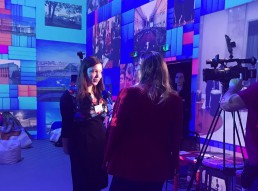
Today, we caught up with Ioana, a member of Terre des Hommes Child Advisory Board in Romania who took part in the EU Child Participation platform in Brussels on June 27 and 28, helping to shape the platform’s next work plan.
Having volunteered and advised Terre des Hommes, other NGOs and UN entities on strategies and approaches to uphold children’s rights for several years, Ioana is certainly no newcomer to working with adults to make child-focused work more impactful! But it was the first time she had done so with the European Commission. And it was her first visit to Brussels, the capital of the European Union.
We asked Ioana to tell us more about her experience and hopes for the platform.
1. Tell us a bit about yourself
My name is Ioana, but almost everyone calls me ‘Yoyo,’ and I absolutely love it! I’m fifteen years old and I come from Romania. I’ve always had a passion for meeting new people, volunteering, and photography. Recently, I’ve taken up learning how to play the guitar, and it’s been an exciting journey. One thing that people usually don’t guess about me is that I aspire to have a career in business and online marketing in the future.
I’ve always been a firm believer in our power to create meaningful change through volunteering and humanitarian efforts. Over the past few years, this has become one of my greatest passions.
What I love the most currently is campaigning for the environment, child participation and children’s rights.
Each moment spent volunteering, campaigning and working for the common good has given me fulfilment, incredible new information and friendships that will last forever.
2. What does child participation mean to you?
In my view, child participation is, at its core, a fundamental right that ensures children all around the world have the opportunity to express their opinions, especially in decision-making processes that affect their safety and well being.
For us, as children, being able to participate and to speak freely means feeling included and in the end, feeling appreciated as human beings.
I believe that if we are given the opportunity to actively work alongside adults towards a more equitable, safer, healthier world, then our planet will truly flourish.
3. How was your experience being part of this event?
In a word, enlightening! The community formed was very involved and open to all our suggestions. I was amazed by how interactive and fun all of the activities were.
It made us feel safe to express our voices. It was great because the organisers made us feel listened to. We talked about our hopes for this platform and our ideas and we discussed these together.
4. Who did you meet, what did you learn and gain from it?
I met several incredible adults who work extremely hard every day to ensure all children’s rights are being respected. I met brilliant young people my age from different countries who have amazing potential. I met a lot of people who are supporting the same initiatives and we bonded over that.
It taught me how important it is to communicate well and how to better articulate my opinion. I’m very glad to have participated as I gained a lot of interesting new information and learned to always search for solutions and personal improvement.
5. What was the best part of your time in Brussels?
The best part of my journey there was being able to exchange different views about our cultures, the beautiful differences that exist between countries, but also the remarkable similarities that join us together. I even learnt some Irish!
Brussels cast a spell on me during my time there – I was utterly captivated. On the first day, we strolled for nearly 10 kilometers, and every step revealed new wonders that I didn’t quite anticipate in the beginning. I would definitely enjoy coming back and revisiting the city in a few years.
6. What are the most important topics that you want the European Commission to focus on in the Platform’s next work plan and why?
I believe that the most important topics for children at the moment are: fighting poverty; protecting them from wars and climate change; helping them have access to quality education and health services; and shielding them from fake news and all types of discrimination.
All these topics ensure that every child’s right to a happy and safe childhood is treated with the utmost importance by the adults responsible. In the end, I believe that each step we take brings us closer to a world where kindness prevails, nurturing the potential within every child.
7. What do you hope the European Commission will do next with all the great ideas that children shared during this meeting?
I sincerely hope that the conclusions we have taken together will be actively implemented. The topics we discussed hold immense significance for young people, and by collaborating with experienced adults from the European Commission, I believe we can start a meaningful change process in the near future.
We are eagerly waiting to see the decisions that will be taken!
8. What comes next for you, Ioana?
I’ll be spending the next few days in the countryside with my grandparents. I plan to edit all the interesting photos I took in Brussels while enjoying the cooler weather. I’m also excited to continue staying engaged in this type of activity and I’m curious to see what will happen with our ideas in the future.
For more details about and photos from the event see here.

Join us as our Child & Youth Participation Advisor (Environment & Climate)
Position: Child and Youth Participation Advisor (Environment and Climate)
Location: Geneva/Switzerland, Brussels/Belgium, Italy or Germany (possibility to be home-based)
Contract: 80% – 100% depending on location. 18-months contract with possibility of extension
Start date: October 2024
Other: Regular travel to Geneva and Brussels, costs will be covered
About Terre des Hommes International Federation
Terre des Hommes International Federation (TDHIF) is a leading child-focused independent non-profit global network, composed of nine Member Organisations in Europe.
TDHIF thrives to guarantee that every child has a safe and enjoyable childhood, that every young person feels empowered and that every community we work with is engaged. Together with children, we fight to ensure that child rights are respected in full and implemented, leaving no one behind, and we engage to influence political agendas and strategies that affect children and young people. We do that through our 890 projects in 68 countries, as well as through global, regional and national advocacy and campaigns, run for and with children and young people.
TDHIF is supported by an International Secretariat with a team of 6 people located in Brussels and Geneva, focussing on essential advocacy, representation and coordination.
Context
TDHIF achieved an important milestone on the pathway to recognising and implementing children’s environmental rights with the UN Committee on the Rights of the Child’s General Comment No.26 (GC26) published in 2023. The support of strong child participation in the process resulted in more than 16,000 contributions of children from across 121 countries.
TDHIF seeks to expand its work connecting child and youth participation to children’s environmental rights, by enhancing coordination between TDHIF’s members and contributing to relevant global movements. TDHIF’s priorities focuses on supporting children and youth to participate and have a voice in campaigning and communication opportunities, as well as raising awareness of children and youth’s important work and initiatives on the environment.
Purpose of the role
As Child & Youth Participation Advisor you will support the implementation of the Federation’s Advocacy Strategy on Children’s Right to a Healthy Environment, in particular the child and youth participation strand. This Strategy is led by the TDHIF Advocacy Task Force on Children’s Rights and the Environment and includes International Secretariat’s team members and experts from TDH Member Organisations.
You will provide expert advice on the development of, and lead on the implementation of child and youth participation components of the Strategy at global level.
Key responsibilities
Supporting child and youth participation
- Develop the plan for the child and youth participation strand of the Advocacy Strategy on Children’s Rights and the Environment
- Lead on documenting existing experience, capacities and learning from within TDHIF on child and youth participation and the environment, including the GC26 process.
- Support and facilitate the participation of children and young people in advocacy opportunities in line with the Strategy, overseeing the process to ensure their safe and meaningful participation.
- Develop guidance and tools for TDHIF to partner with children and youth as part of the Strategy. Build capacity of TDHIF colleagues in this regard.
Advocating for child and youth participation
- Support the advocacy strand of the Strategy, including by contributing to the development of communications and advocacy outputs and materials.
- Advocate at different levels for spaces and support for safe and meaningful participation of children and youth.
- Engage with external stakeholders and coalitions working in relevant fields: UN institutions, NGOs, networks, and foundations.
Fundraising and Communications
- Support the development of TDHIF fundraising proposals to fund the advocacy strategy and the child and youth participation implementation plan.
- Work with communications colleagues to ensure visibility of TDHIF’s work to support and promote child and youth participation.
General
- Participate in TDHIF meetings, including of the Advocacy Task Force on Children’s Rights and the Environment and the Child and Youth Participation Task Force.
- Comply with TDHIF’s internal systems, processes and policies, including around child and youth safeguarding.
Profile
Education
- A university degree or equivalent professional experience in relevant field.
Experience and Skills
- About 3 years-experience in working with children and young people and designing and implementing child and youth participation advocacy activities. Ability to advise colleagues and partners on designing and delivering effective engagement with children and young people.
- Previous experience in advocacy and/or campaigning specifically in the areas of child rights and/or environmental protection, as well as experience in fundraising.
- Knowledge and understanding of the UN system and international decision-making processes and how they may be influenced.
- Excellent communication skills and ability to communicate efficiently with different audiences, especially with children and young people.
- Good facilitation skills and knowledge of participatory approaches, particularly with children and young people (online and in person).
- Fluency in written and spoken English.
- Being an effective networker and team player.
- Capacity to work autonomously, following deadlines and focusing on results.
- Working proficiency in French and/or Spanish are welcome.
Child safeguarding
The Child and Youth Participation Advisor must commit to Terre des Hommes‘ Child Safeguarding Policy.
General conditions
- Indicative monthly gross salary of min. 3700 EUR for a full-time position based in Brussels, depending also experience. For other locations, salary will be adjusted based on the cost of living of the country you will be based in.
- The contract will be established in line with the labour laws of the country where the role will be located
- Applicants to this position need to be eligible to work in Switzerland (EU/EFTA nationals or in possession of a valid work permit), or in the EU.
- This position is open to hybrid working
How to apply
(as this position is reposted, previous applicants need not apply)
Please send your CV and a cover letter (no more than 500 words) to jobs@tdh.de by 6th August 2024. Interviews will be conducted in August.
We will only contact shortlisted candidates. Due to the large number of applications, we unfortunately cannot provide personal follow-up to the larger candidate pool. We thank you for your understanding.
Youth advocates push for climate action at the UN Human Rights Council
Youth advocates push for climate action at the UN Human Rights Council
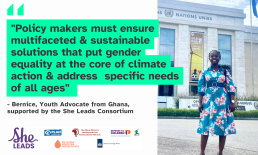
Climate change is causing an alarming amount of loss and harm to people’s lives and means of subsistence worldwide. Droughts and irregular rainfall patterns brought on by climate change cause crop failures, livestock losses, and even the destruction of homes worldwide. As a result, smallholder farmers who cannot afford to rebuild their homes are forced to flee their homes and seek safety elsewhere. Millions of people have been displaced, disrupting their lives and livelihoods and further limiting their access to basic necessities.
Women, especially young women and girls, are the first and most impacted in any crisis, whether natural or man-made. Socio-cultural norms and gender roles often dictate that girls and young women are responsible for meeting the needs of their families. As a result, they face numerous challenges, such as early marriage for financial gain, dropping out of school to care for family members, and exposure to severe safety risks while living as refugees. These socio-cultural expectations exacerbate the adverse impacts of climate change on girls and young women, who bear the brunt of multifaceted inequalities.
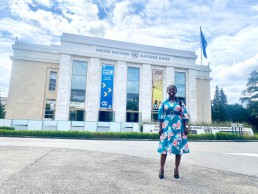
These were the messages shared yesterday by youth advocate Bernice from Ghana at the UN Human Rights Council 56 (HRC56) event supported by the She Leads Consortium. Terre des Hommes Netherlands is a member of the She Leads Consortium which aims to increase the influence of girls and young women in decision-making and the transformation of gender norms in formal and informal institutions. Three youth advocates Felicity, Korotoumou and Bernice supported by the She Leads Consortium are advocating for multiple priorities including on climate and new technologies at the HRC56.
As the impact of climate change is a gender and age-sensitive issue that demands gender and age-appropriate solutions, young people urge Member States to take into account multifaceted and sustainable solutions that put gender equality at its core and address the specific needs of all age groups.
She Leads is a five-year joint programme of Plan International Netherlands, Defence for Children – ECPAT the Netherlands (DCI-ECPAT), African Women’s Development and Communication Network (FEMNET), and Terre des Hommes Netherlands (TdH NL), in partnership with the Ministry of Foreign Affairs of the Netherlands.
Voices of young people: Empowering every child in the EU to have their say
Voices of young people: Empowering every child in the EU to have their say
Around 40 children from 15 EU Member States, aged 10 to 17, are gathering in Brussels from 26 to 28 June for an event organized by the European Commission as part of the activities of the EU Child Participation Platform, which was established last year.
Terre des Hommes is strongly committed to meaningful, inclusive and safe child participation and is proud to support the EU Child Participation Platform’s mission to ensure children’s voices are heard and help children across the EU realise their right to participate in decision making and share, learn and connect with others.
The upcoming EU Child Participation Platform event is set to kick off on June 26th with the active participation of child advocates. Terre des Hommes is supporting 15-year-old Ioana, a passionate advocate from Romania, to participate in the event and discuss with decision-makers how to make important decisions in the European Union on laws, policies and issues that she and other children care about.
Ioana’s journey symbolizes the essence of the Platform: empowering children to actively engage in shaping the policies that affect their lives.
“When I first heard the news that I would be coming to Brussels and be part of this meeting I was overjoyed as it is an incredible opportunity for us children to make our voices understood. This remarkable opportunity allows us, as children, the privilege to express our voices and actively contribute to the creation of a safer and more welcoming environment for all children worldwide” said Ioana.
Ioana and her peers will have the opportunity to share their insights, learn from one another, and connect with key stakeholders, including representatives from the European Commission.
During the event, children will review the EU Child Participation Platform’s activities and outcomes from 2023-2024, gather feedback on necessary changes and initiatives should be carried forward, and define key priorities for the next Platform’s work plan.
This Platform provides an important space for children to connect and discuss with decision-makers on how to make impactful decisions on issues that matter most to them.
“During my discussions with the other young people and decision-makers, I hope to highlight several critical topics the Platform should work on. These include safeguarding children from the adverse impacts of climate change and environmental disasters, advocating for their right to quality education and overall well-being, protecting them from harmful content and misinformation, and finding ways to help children on the move feel safe and integrate in their new community”.
Stay tuned as Ioana and other young champions take center stage, bringing their unique perspectives and innovative ideas to the forefront and moving us towards a more inclusive and representative future for all children in the EU.
Terre des Hommes hopes that the Platform will be used systematically in the EU policy and decision making in the years to come.
For more information on the platform, visit the EU Child Participation Platform
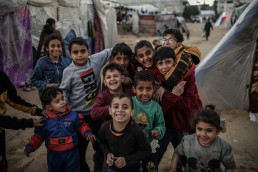
States must put children’s rights at the heart of the Pact for the Future
States must put children’s rights at the heart of the Pact for the Future
The CEOs of Joining Forces, of which Terre des Hommes is a member, call on UN Member States to put children’s rights at the heart of the Pact for the Future ahead of the Summit of the Future in September.
The United Nations Summit of the Future, scheduled for September 22-23, 2024, in New York, will see world leaders agreeing on the Pact for the Future. This Pact aims to re-energise international consensus and cooperation around existing agreements and commitments to deliver a better present and safeguard the future for our world. The Pact has the potential to significantly improve the tools and systems in place to fulfil child rights in addition to ensuring that all children can live and flourish in safety and peace. Children represent one-third of the world’s population, and an estimated 4.2 billion children are expected to be born over the next 30 years.
As leaders of child-focused international non-governmental organisations, we acknowledge and welcome the proposals put forward by a number of Member States on the zero draft of the Pact on children yet are alarmed that very few of these proposals were incorporated into Rev 1. Regrettably, the current draft of the Pact barely mentions children even though all the issues covered under the Pact directly impact children and their rights. There are significant intersections between the full spectrum of children’s rights, and particularly their rights to health, nutrition, social protection, education, participation, protection and non-discrimination; and the five chapters of the Pact: sustainable development; peace and security; science, technology and innovation and digital cooperation; youth and future generations; and transforming global governance. Failing to recognize these intersections will have negative consequences for children alive today and those who are yet to be born. Additionally, there is a concerning lack of emphasis on the specific needs and rights of girls, children with disabilities and other marginalized groups who face unique challenges and require tailored support to thrive. The future of the multilateral system rests on the shoulders of children. If they are not considered as stakeholders today, then how can world leaders expect them to carry forward the promises of multilateralism into tomorrow?
In recent years, children have spoken out and demanded change related to a range of critical issues such as the climate crisis, gender equality, racism, violence, police brutality, the fight against oppression, and the impacts of COVID-19. However, children are still not systematically and meaningfully included in decision-making processes at all levels, from the local to the global. This exclusion is even more pronounced for girls, whose voices and experiences are often overlooked, despite their critical insights and contributions.
Over the last year, we have talked to children around the world as part of our Call to Action for Child Participation. Their message was clear: children are the protagonists of the change that their countries need; they have a right to be part of decisions that affect their future. Also, in the recently released report, Girls’ Pact for the Future, girls and young women said that they are worried about the future of gender equality. Girls and adolescent girls emphasised the crucial need to be actively involved in decision-making spaces and to have their unique needs and rights recognised and addressed in these decisions.
If UN Member States make the mistake of leaving children out, countries will simply not be able to properly plan for the future, address new challenges, or achieve the 2030 Agenda. Children are not just younger versions of adults or part of the “youth” category, they are a distinct group with unique rights and perspectives. The UN Convention on the Rights of the Child clearly defines “children” as individuals under the age of 18. It recognises them as a separate and important demographic that requires special attention and protection, as well as rights holders with the capacity to inform decision-making that impacts them. They are the present and the future and will be the most affected by any agreements established in the Pact for the Future for years to come.
As leaders of organisations dedicated to the rights, well-being and future of children worldwide, we call on Member States to:
- Put child rights at the centre of the Pact, with a strong emphasis on gender equality and the empowerment of children in all their diversity
- Ensure that children, in all their diversity are able to meaningfully and safely participate in the shaping and implementation of the Pact of the Future, recognizing and addressing the specific barriers they face;
- Strengthen their commitment to and prioritise investment in child education, health, social protection, care and the protection of children from violence with targeted initiatives to close gender gaps and promote the rights of children in all their diversity;
- Prioritise the protection of children affected by armed conflict as a critical aspect of resolving conflict and sustaining peace and implement specific measures to protect girls from gender-based violence and exploitation in these contexts.
- Address barriers to children’s access to digital technologies and ensure their safety and protection from risks associated with it.
The future of our world depends on our ability to respect, protect and fulfil the rights of our children today and tomorrow. By acting on these proposals and involving children as equals, Member States can ensure that the Pact for the Future sets the stage for a more sustainable, safe, inclusive, and just global system.
We are ready to support and work with governments and international bodies to achieve these goals. Together with children, we can build a world where cooperation, peace and prosperity are ensured and pursued by and for all, including every child.
Signed,
Meg Gardinier Secretary General, ChildFund Alliance
Debbie Simpson Interim CEO, Plan International
Inger Ashing CEO, Save the Children International
Angela Rosales Acting CEO, SOS Children’s Villages International
Valérie Ceccherini Secretary General, Terre des Hommes International Federation
Andrew Morley President and CEO, World Vision International
Read the joint statement from Joining Forces here.
About Joining Forces: Joining Forces is an alliance of 6 international NGOs working with and for children to secure their rights and end violence against them.
“We are all children, and we all have rights”: This World Refugee Day, we celebrate the power of children’s participation
“We are all children, and we all have rights”: This World Refugee Day, we celebrate the power of children’s participation
To truly understand and meet the needs of children on the move, we must put children at the heart of refugee responses. Giving refugee children a seat at the table and empowering them to participate in decision-making will leads to better policies and protection of their rights.
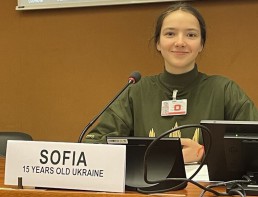
Earlier this year, Terre des Hommes supported Sofia, a 15-year-old girl from Ukraine who is now living in Romania, to be part of an intergenerational dialogue on protecting children on the move in times of crises during the United Nations Human Rights Council in Geneva. On World Refugee Day, we highlight some of Sofia’s recommendations for governments:
“Children who left home because of the war have not chosen this path. They are not guilty for that. Because of the war, children lost everything they had, including their education and the things they could develop with. Governments should improve children’s education. It is an important part of children’s lives, and we can’t just stop living because of the war that came into our country. No-one knows when war will end. But access to our rights should not stop and start.
If children don’t agree with how their rights are respected, the government should hear them talk about these issues because one of the most important child rights is to share our thoughts freely and the right to be heard.
The government should organise events … so that people hear from refugees and children who experienced leaving their homeland and coming to another country with nothing. After that, people will understand and be more welcoming and they will change the way they think about refugees. Children like me have an experience that not all children have had. But at the same time, we are all children.”
Sofia has always dreamt of travelling the world and going to space: she wants to be an astronaut one day.
But for now, she hopes for peace: “My dream would be that I could come back home. Violence in our country and in our world is not correct, it’s not right, and it must not happen anywhere, never again in the world”.
Policies and programmes to support refugee children are more effective when they are informed by the views and experiences of children like Sofia – children who know what it means to be forced to leave their home and find safety and protection in another country. Sofia wants to be heard and for governments to act:
“I hope that people listen to me so that I can make a difference for my country and other countries that experience war, and that violence in other countries and in my country would stop so that there is no more pressure on kids and they can live a happy life, with no madness or violence against children.”
For guidance on engaging refugee children safely and ethically as key actors and partners, read the publication published by Destination Unknown, a network led by Terre des Hommes, and IICRD: ‘Working in Partnership with Children & Young People on the Move – Strategies for Meaningful Participation’.
Attention academics in Europe: your voice counts for the environment!
Attention academics in Europe: your voice counts for the environment
Terre des Hommes is proud to support a campaign for an additional protocol recognising the right to a healthy environment at the Council of Europe.
Over 450 civil society, social movements, and Indigenous Peoples organisations, including Terre des Hommes, earlier this year joined forces to call on the Council of Europe to explicitly recognise the right to a clean, healthy, and sustainable environment in the European human rights framework.
We now encourage academics, scholars and researchers to join their voices with ours and sign a letter urging permanent representatives of the member states of the Council of Europe to act.
The explicit protection of the right to a clean, healthy and sustainable environment is especially crucial for those who face the greatest risk of environmental harm, such as children, young people, women, Indigenous Peoples, national minorities, individuals living in poverty, persons living with disabilities, older persons, refugees and migrants, displaced people, and other disproportionately impacted groups.
As the letter concludes:
Faced with unprecedented crises, the time is now for the Council of Europe to fulfil and reaffirm its mandate to promote democracy, the rule of law, and human rights in all member states by recognizing and protecting the right to a clean, healthy, and sustainable environment through the adoption of a Protocol to the European Convention on Human Rights.
Read the full letter in English, French, German and Spanish.
Endorse the letter here.
Share it with academic colleagues in Europe!
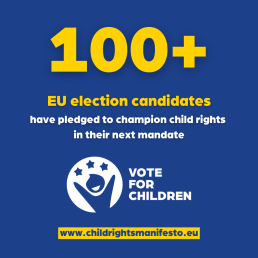
Child rights experts call on future European Parliament members to become Child Rights Champions
Child rights experts call on future European Parliament members to become Child Rights Champions
EU Election candidates are invited to sign the Child Rights Manifesto and form a new Intergroup on Children’s Rights.
The 23 child rights organisations that form the #VoteforChildren coalition launched on 21 March a campaign to ask candidates to secure and advance children’s rights by:
- Mainstreaming and protecting children’s rights
- Breaking the cycle of poverty and inequality by investing in children
- Engaging with children
As part of the campaign, the coalition produced a Manifesto in advance of the upcoming EU Elections on 6 to 9 June 2024 outlining concrete measures to address the challenges faced by children. From education to mental health, from bullying to violence prevention as well as climate and environmental degradation, the manifesto advocates for policies that prioritise children’s well-being. It’s a call to action—a commitment to ensuring that every child’s voice is heard and their rights protected at all levels of decision-making.
The campaign hopes to see a new Intergroup on Children’s Rights being formed after the elections. The Intergroup is a formal body in the European Parliament that mainstreams children’s rights and assesses the impact of legislative and non-legislative work on children. It is a cross-party, group of committed members of the EU Parliament, who work with child-focused organisations to keep children’s rights on top of the EU agenda.
During the campaign launch at the European Parliament in Brussels on 21 March 2024 the #EuropeKidsWant survey results were also unveiled. Over 9,200 children from diverse backgrounds and across Europe were consulted and shared their concerns and aspirations. 80% of children worry about global conflicts, half of them feel unsafe online, 70% of children are worried or very worried about the impacts of climate change.while 36% of LGBTQI+ children reported insecurity within their own homes. Under each survey topic, there are some key recommendations for EU policymakers. Read the full report to know more about what children want and to read recommendations for the new Members of the European Parliament and European Commission leadership.
The children’s ask is clear: they want the EU to act now to protect their present and build a brighter future!
Sign the Manifesto now and commit to becoming a Child Rights Champion in your next mandate
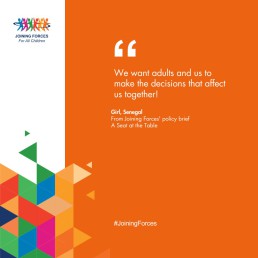
Joining Forces urgently calls for greater financial investment and political will to support child participation in decision making as global crises intensify
Joining Forces urgently calls for greater financial investment and political will to support child participation in decision making as global crises intensify
Existing and emerging conflicts and the intensifying climate crisis are exacerbating threats to children’s rights around the world. At the same time, the rapidly expanding digital environment is creating opportunities, but also exposing an increasing number of children to new risks of violence online.
In response, Joining Forces, an alliance of 6 international NGOs working with and for children, is calling for greater financial investments and political will by governments and the wider international community for children’s systematic participation in decision-making processes. Children’s participation leads to better informed and more effective policies and solutions to the many challenges children currently face.
On 21 May 2024 Joining Forces is bringing together children, government decision makers and other critical stakeholders to discuss the importance of child participation and launching the new policy brief: A Seat at the Table: Investing in children’s participation as a cornerstone of children’s rights. Informed by experiences and consultations with children, the brief highlights the urgent need to focus on, and invest in, meaningful and equitable participation of children in public decision making.
International law says that children have a right to be heard and adults have a duty to listen. Yet, against a backdrop of declining political rights and civil liberties, these rights are increasingly under threat.
Specifically, the Joining Forces alliance is calling on governments to:
• Strengthen legal and policy frameworks guaranteeing children’s right to be heard as well as their civil and political rights, as enshrined in the UNCRC
• Establish and institutionalise structures and mechanisms for equitable and inclusive child participation
• Invest in child participation mechanisms, across sectors and at all levels of government
• Strengthen children’s capacity, confidence and knowledge to participate in decision making
• Support the capacity and willingness of adults to facilitate and enable children’s meaningful and ethical participation
The right to be heard is fundamental to fulfilling the full spectrum of children’s rights, including children’s civil and political rights, and is no less important than adult’s right to express themselves freely about matters that affect them. With only six years remaining to achieve the ambitions of the 2030 Agenda for Sustainable Development, there is an urgent need to strengthen and invest in children’s participation now.
Quotes from Joining Forces’ leaders:
“Children bring a valuable richness to problem-solving by sharing their diverse perspectives and experiences. Joining Forces is calling for more investment in children’s participation: it is not just a right, but a catalyst for innovative solutions to the complex issues faced by children around the globe.” Meg Gardinier, Secretary General, ChildFund Alliance
“Children bring a wealth of different perspectives and experiences to the table. We must be sure to make concerted efforts to amplify the voices of children, especially girls in all their diversity, who are even more excluded from decision-making spaces.” Kathleen Sherwin, Chief Strategy and Engagement Officer, Plan International
“Despite representing over 30% of the world’s population, children are still not systematically included in decision-making. It’s time to change this narrative, children’s rights must be heard and prioritised, now.” Inger Ashing, CEO, Save the Children International
“Joining Forces calls for economic investments and political will by governments to create enabling environments for meaningful child participation for all children, including those without parental care or in families at risk of breakdown.” Angela Rosales, Acting Chief Executive Officer, SOS Children’s Villages International
“We need to listen to and engage with children and implement laws and policies that guarantee their rights. Joining Forces calls for guaranteeing more seats for children at the table. The benefits of prioritising children today will echo for years to come and will contribute to a better future.” Valérie Ceccherini, Secretary General, Terre des Hommes International Federation
“Children have every right to be heard. Their voices are the most powerful of all, and leaders must listen. Above all, they must make real commitments to empower girls and boys everywhere to achieve their God-given potential in life.” Andrew Morley, President and CEO, World Vision International
ENDS
The online launch of the call to action on participation is at 14:00 BST (09:00 EST), 21 May 2024. Register for event here.
The policy brief is available from 21 May here.
About Joining Forces
Joining Forces is an alliance of 6 international NGOs working with and for children to secure their rights and end violence against them.
‘A sell-out of international cooperation’: DG INTPA turns its back on commitments to put human development at the centre of its international cooperation in leaked briefing
‘A sell-out of international cooperation’: DG INTPA turns its back on commitments to put human development at the centre of its international cooperation in leaked briefing
Brussels, 22 April 2024 – The recent leak of the draft Briefing Book from the Department for International Partnerships (DG INTPA) for the next Commission sparked anger among CONCORD and its members.
DG INTPA, entrusted with supporting its partner countries on their path to sustainable development, reducing poverty, and promoting human rights, has taken a shocking turn toward prioritising competition and EU-centric interests, particularly in securing critical raw materials.
“We’re truly shocked that DG INTPA’s vision of international partnerships for the next five years is basically a trade and investment strategy for the EU based on its geopolitical interests. Those interests are defined by competition and the EU’s economic security. Nowhere do we see a concern for the priorities of partner countries, let alone an interest in ensuring that people’s lives are improved. “People” are totally missing from the Briefing Book. This proposal is selling out international cooperation, quite literally!”
Rilli Lappalainen, President , CONCORD
While we understand that new approaches should be tried and we acknowledge the potential of the Global Gateway if it had a people-centred focus aimed at reducing inequalities, we have concerns about the current direction. The Briefing Book raises serious issues and undermines international cooperation, potentially reversing years of progress. It’s important to note that the Global Gateway, while significant for the EU’s economic security strategy, is not a comprehensive answer from the EU to the multifaceted challenges faced by partner countries.
The brief is silent on the impact of inequality, power relations and undemocratic trends on current world events and insecurity. Investment projects alone don’t hold the key to addressing the multiple crises that partner countries are confronting. The so-called “traditional and narrow development and foreign policy approaches” have a real role to play in the EU’s partnerships to bring peace, security, equality, and well-being to the world. The world urgently requires cooperation, not a race to exploit other countries’ natural resources.
“Investment projects alone don’t hold the key to addressing the multiple crises that partner countries are confronting. Investments in transport in return for cobalt will not solve the world’s crises. The so-called “traditional and narrow development and foreign policy approaches” have a real role to play in the EU’s partnerships to bring peace, security, equality, and well-being to the world. The world urgently requires cooperation, not a race to exploit other countries’ natural resources.”
Naima Charkaoui, Advocacy Director, 11.11.11 (Belgian umbrella for international solidarity)
Civil society organisations are calling for immediate commitments from the European Commission to realign its international cooperation efforts with sustainable development goals (SDGs). The EU’s credibility and reputation as a reliable partner hinge on its ability to reaffirm commitments to global welfare and human rights.
For media inquiries, please contact:
Celia Cranfield, Head of Advocacy, at celia.cranfield@concordeurope.org
Camilla Falsetti, Communication and Media Adviser at camilla.falsetti@concordeurope.org