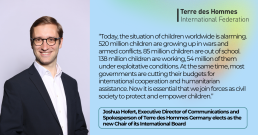
Joshua Hofert becomes the new Chair of the Terre des Hommes International Federation
Joshua Hofert becomes the new Chair of the Terre des Hommes International Federation
The General Assembly of the Terre des Hommes International Federation, an association of national Terre des Hommes member organizations, elected Joshua Hofert as the new Chair of its International Board last Friday. The 29-year-old also serves as Executive Director of Communications and Spokesperson of Terre des Hommes Germany. Prior to his appointment as Executive Director in 2022, Joshua Hofert worked in programs and policy with Terre des Hommes, with the United Nations in Bangkok and the German Federal Foreign Office in Berlin.
Anne Hassberger, Secretary General of Terre des Hommes Suisse, was elected Vice Chair, and Paolo Ferrara, General Director of Terre des Hommes Italy, was confirmed as Treasurer of the International Board.
“I am honored to serve as the new Chair of the Terre des Hommes International Federation,” says Joshua Hofert. “My paths with Terre des Hommes crossed 15 years ago. Ever since, I have valued the partnerships with local organizations in the Global South and the participation of children and youth where Terre des Hommes has great experience. Today, the situation of children worldwide is alarming. 520 million children are growing up in wars and armed conflicts. 85 million children are out of school.138 million children are working, 54 million of them under exploitative conditions. At the same time, most governments are cutting their budgets for international cooperation and humanitarian assistance. Now it is essential that we join forces as civil society to protect and empower children.”
The Terre des Hommes International Federation is an association of child rights organizations based in Europe. Last year, its member organizations funded 983 projects in 68 countries worldwide, supporting nearly seven million children, youth and their communities. Together, Terre des Hommes has more than 250,000 members and supporters. In the Federation, program and advocacy efforts are coordinated among its independent member organizations.
“Anne Hassberger, Paolo Ferrara and I are looking forward to strengthening the important work of the Terre des Hommes International Federation and its impact for children worldwide,” Joshua Hofert concludes.
_____________________________________________________________________
Responsible: Terre des Hommes
Wolf-Christian Ramm, +49 541 71 01 158 or +49 171 6729748, c.ramm@tdh.de, www.terredeshommes.org

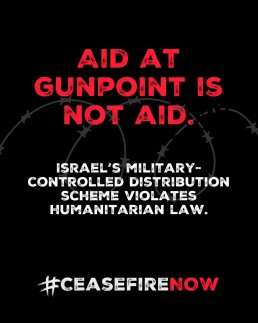
Civil society demands immediate end to deadly Israeli distribution scheme
Civil society demands immediate end to deadly Israeli distribution scheme
In less than four weeks, more than 500 Palestinians have been killed and almost 4,000 injured just trying to access or distribute food in Gaza.
This is not a humanitarian response.
Terre des Hommes International Federation, together with over 150 civil society organisations, urge states to end the deadly Israeli food distribution scheme in Gaza, revert to the UN-led aid coordination mechanism grounded in International Humanitarian Law, and lift the Israeli government’s blockade on aid and commercial supplies.
Read the statement and find the list of signatories here.
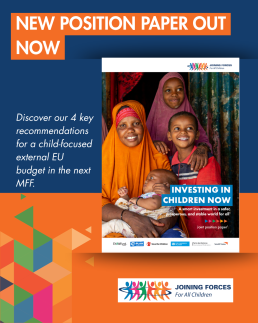
New position paper out on investing in children as an investment in a safer, prosperous, and stable world
New position paper out on investing in children as an investment in a safer, prosperous, and stable world
Investing in children is a smart investment in a safer, prosperous, and stable world for all.
As the EU starts planning the next Multiannual Financial Framework (#MFF) 2028-2034, it has both a big opportunity and a clear responsibility: putting children at the centre of its humanitarian and development efforts.
In a newly launched position paper, Joining Forces – an alliance of the six largest child-focused international NGOs, including Terre des Hommes International Federation – outlines its key recommendations for the next MFF.
🔹Put the most vulnerable children at the centre of the external dimension of the MFF
🔹Keep separate the EU’s external financing instruments, to address children’s specific needs
🔹Ensure ambitious child-focused ODA funding across these three funding instruments
🔹Track and report the levels of child-focused external investment.
Read the complete position paper by Joining Forces members ChildFund Alliance, Plan International EU Office, Save the Children Europe, SOS Children’s Villages International, Terre des Hommes International Federation and World Vision EU Representation here.
From Cerro de Pasco to the Sundarbans: How children and youth are fighting back with General Comment 26
From Cerro de Pasco to the Sundarbans: How children and youth are fighting back with General Comment 26
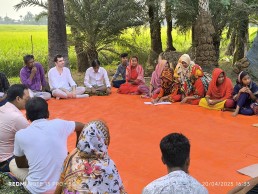
How can General Comment No. 26 be used as a powerful tool for justice? Can it be a way to raise our voices and involve other young people? These were some of the questions debated by child and youth activists and child rights and environmental campaigners during an interactive workshop organised by Terre des Hommes, Future Rights, the Child and Youth Advisory Committee (CYAC) of the Congress, and Red Interquorum Pasco (a youth activist group in Cerro de Pasco) during the World Congress on Justice with Children on 4 June 2025.
Using UNCRC General Comment 26 as a lens, participants studied children’s experiences in Cerro de Pasco in Peru and the Sundarbans delta region and explored how justice for and accountability towards children can increase when children and their rights are prioritised in environmental decision-making. Participants also considered how children’s identities affect their experiences of environmental degradation and climate change.
The situation in Cerro de Pasco and Sundarbans highlights the detrimental effects of environmental harm and climate change on children. Failure to uphold children’s rights in both contexts is a powerful reminder that environmental harm is injustice. Discrimination – especially against indigenous children – compounds environmental injustice. Rights violations in these situations are not only technical failures, but deeply rooted in social, political, and historical inequalities. Elisa Morgera, UN Special Rapporteur on Climate Change and Human Rights, highlighted the same, saying that when we reflect on General Comment 26, any decision from the State that has allowed for environmental degradation to occur has discriminated against children because they are more vulnerable to the effects. Anything that harms their rights is discriminatory to children.
How can we change this?
Here are some of the recommendations from participants at the workshop:
- Place children’s rights at the centre of environmental and climate justice efforts. That means not just recognising harm but challenging the systems that produce it. It means standing with children and communities on the frontlines as allies.
- Ensure that children, particularly marginalised children, are better able and empowered to access justice in environmental and climate crises, and more specifically that children are:
- Empowered as human rights defenders;
- Protected from retaliation and harm;
- Supported to shape their own futures including through education on environment, climate, child rights and accessing justice; and
- Able to access the services they need to fully enjoy their rights and thrive.
- Address systemic discrimination which is closely linked with environmental harm in both examples. Decisions about where to permit polluting industries, where to invest in services, and whose voices are heard reflect deeply unequal power dynamics. Participants highlighted colonial legacies and extractive economic models that continue to shape the realities of many communities. These structural factors need to be addressed, or interventions will remain superficial and insufficient.
- Learn from children’s knowledge which is rooted in lived experience. A central message of the workshop was the need to listen to children not just as symbolic voices, but as experts in their own right and as equal rights holders. As one participant said, “Children are not waiting to be included—they are already participating, observing, and imagining better futures.” Children’s unique perspectives expose the failures of current systems and hold the potential to reframe what justice means in environmental contexts.
- Shift power. Strategic litigation can be a powerful tool but is not enough. An interdisciplinary approach and more awareness on rights and legal frameworks is needed. Legal efforts have brought cases to regional and international courts and are beginning to force governments to reckon with their obligations. But the extent to which this is a viable pathway to justice was questioned by participants, especially for marginalised children such as indigenous girls in remote communities. Participants stressed the need for:
- Stronger accountability frameworks for companies
- International enforcement mechanisms
- Greater investment in child-friendly environmental and climate education
- Laws that protect the right to protest and organise.
- Critically, reforms must be co-designed with children and communities.
- Ensure enabling environments, trust, and accountability mechanisms that protect environmental human rights defenders. Children’s rights to access information, participate, express themselves and form or join a peaceful assembly are crucial to ensure child environmental defenders can access justice when their rights are violated because of environmental degradation and climate change.
- Support children as experts in their own stories. Provide tools and facilitate spaces and conversations where children and youth can tell their own stories on their own terms.
- Strengthen governance and accountability. Participants felt that government actors either lack the power or the will to hold industries accountable, and that corruption, political instability, and corporate lobbying can obstruct reform and, in some situations, suppress community resistance. Criminalisation of NGOs and activists is also increasing and very concerning. Shrinking civic space leaves children and families without allies to help amplify their concerns.
The workshop highlighted the need for child-friendly resources for children and young people to use General Comment 26 as a means to analyse different climate and environmental crises – such as tools to identify key violations of children’s environmental rights, help understand which groups of children are most affected, recognise who is responsible, and determine pathways to seek justice through the different mechanisms and laws available. Developing such tools will be a concrete follow-up to the workshop – led by children and youth who were central to the design and delivery of the workshop.
“As young people, we feel the responsibility to raise our voices — to demand that our rights be respected: the right to a healthy environment, the right to health, and the right to a dignified life.” (Mireya and Norman, Members of Red Interquorum)
CASE STUDY 1: PERUVIAN CITY OF CERRO DE PASCO
“The world needs to see what is happening here. Environmental degradation directly affects children but also devastates vulnerable families who are unable to protect their children’s well-being. This crisis touches every corner of the community.” (Katty and Rosa, Members from Red Interquorum Pasco).
Children grow up with environmental devastation caused by open-pit mining. Poisoning lead and other heavy metals is widespread with devastating health impacts. Despite multiple declarations of health emergencies and international concern, the Peruvian government has failed to deliver essential services like clean water, social protection, adequate healthcare, and education for children with mental and physical impairments.
There are limited spaces for children to raise their voices safely. Children are surrounded by destruction which has become normalised, often leading to a sense of hopelessness. They are often seen as victims rather than rights-holders. Harm has been normalised in a context where mining companies are powerful, government institutions are weak and there is little accountability from companies.
“As young volunteers, we continue our fight for environmental justice. But we need the support of civil society in these key areas: Awareness and outreach, Legal and technical strengthening, Mobilisation and coordination, and Political advocacy and financial support.” (Rosa, Member of Red Interquorum)
Watch the video by Red Interquorum here.
CASE STUDY 2: THE SUNDARBANS DELTA IN SOUTH ASIA
Children face increasingly frequent floods, cyclones, and displacement due to climate change, threatening many of their rights.
The harm is real but hard to attribute. There is no single polluter and no clear chain of accountability. The impacts unfold gradually, often in ways that evade international attention.
The most affected are those who have contributed the least to the crisis.
Child activist, Dhruv, shared how children are keenly aware of this.
“I started my activism when I was quite young, and I did not know about rights. I did not know I had those. But I knew which services were missing or failing – children know this straight away. I come from a community where I had access to information from outside, so I knew children from other countries were not affected like me…it is important to learn from children and their experiences.”
Watch the video by TDH on the impact of climate change on children here.
Terre des Hommes advocates for stronger child safety measures in the guidelines under Art. 28 of the Digital Services Act
Terre des Hommes advocates for stronger child safety measures in the guidelines under Art. 28 of the Digital Services Act
“There is a lot of content on the internet that can have a negative impact on us.”
—Child from Romania, Down to Zero Alliance research
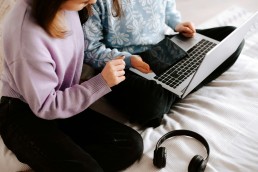
Terre des Hommes has submitted key recommendations in response to the European Commission’s consultation for feedback on the draft guidelines under Article 28(1) of the Digital Services Act (DSA).
We welcome the guidelines which mark a crucial step toward enhancing online safety for children, addressing risks such as addictive design, cyberbullying, sexual exploitation, and exposure to harmful content. Terre des Hommes strongly supports the child rights-based approach in the draft but calls for further improvements to ensure robust protections.
Key Recommendations:
1. Child-Centered Guardian Controls
- Tools should promote communication and learning rather than fear-based restrictions.
- Graduated controls should be introduced—more active support for younger children (under 13) and collaborative oversight for adolescents (13–17).
- Features like shared dashboards, opt-in/out options, and transparency should empower both children and caregivers.
2. Meaningful Child Participation in Design
- Platforms must co-design safety features with children, moving beyond token consultations.
- Inclusive participation should align with UNCRC standards, ensuring diverse voices shape digital safety solutions.
3. AI Tools Designed for Child Safety
- AI must not be used to market products to children or push harmful interactions.
- Platforms should provide age-appropriate explanations, easy opt-out options, and digital literacy tools to help children navigate AI safely.
4. Mandatory Child Rights Impact Assessments (CRIA)
- All platforms should conduct systematic CRIAs, evaluating risks to privacy, protection, and well-being.
- Assessments must consider intersectional vulnerabilities (disability, migration status, etc.) and involve children and experts.
- Results should be independently audited and published, including child-friendly summaries.
5. Zero Tolerance for Harmful Content
- A clear definition of harmful content—covering both illegal and age-inappropriate material—is essential.
- Platforms must prevent all exposure (not just repeated instances) to harmful content through proactive moderation and safety-by-design principles.
While the draft guidelines on Art 28 (1) of DSA take relevant steps forward on the protection of children online, we call on the European Commission to further strengthen them with these measures, ensuring that digital environments prioritise children’s safety, rights, and well-being. By adopting a child-centered approach, involving young people in decision-making, and enforcing strict safeguards, we can create a safer online world for all children.
Read the full submission here.
Israel’s New INGO Registration Measures Are a Grave Threat to Humanitarian Operations and International Law – 55 Organisations Say
Israel’s New INGO Registration Measures Are a Grave Threat to Humanitarian Operations and International Law – 55 Organisations Say
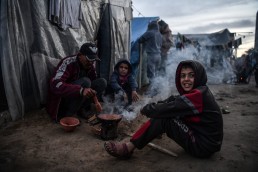
The undersigned 55 organisations operating in Israel and the occupied Palestinian territory (oPt) call for urgent action from the international community against new Israeli registration rules for international NGOs. Based on vague, broad, politicised, and open-ended criteria, these rules appear designed to assert control over independent humanitarian, development and peacebuilding operations, silence advocacy grounded in international humanitarian and human rights law, and further entrench Israeli control and de facto annexation of the occupied Palestinian territory.
For over a year and a half, humanitarian organisations have continued operating despite unprecedented constraints. In 2024, they reached millions of people across the oPt with essential services – from food and water to mobile clinics, legal aid, and education. The new registration rules now threaten to shut this work down. These measures go beyond routine policy. They mark a serious escalation in restrictions on humanitarian and civic space and risk setting a dangerous precedent.
Under the new provisions, INGOs already registered in Israel may face de-registration, while new applicants risk rejection based on arbitrary, politicised allegations, such as “delegitimising Israel” or expressing support for accountability for Israeli violations of international law. Other disqualifiers include public support for a boycott of Israel within the past seven years (by staff, a partner, board member, or founder) or failure to meet exhaustive reporting requirements. By framing humanitarian and human rights advocacy as a threat to the state, Israeli authorities can shut out organisations merely for speaking out about conditions they witness on the ground, forcing INGOs to choose between delivering aid and promoting respect for the protections owed to affected people.
INGOs are further required to submit complete staff lists and other sensitive information about staff and their families to Israel when applying for registration. In a context where humanitarian and healthcare workers are routinely subject to harassment, detention, and direct attacks, this raises serious protection concerns.
These new rules are part of a broader, long-term crackdown on humanitarian and civic space, marked by heightened surveillance and attacks, and a series of actions that restrict humanitarian access, compromise staff safety, and undermine core principles of humanitarian action. They are not isolated but part of a wider pattern that includes:
- Blocking or delaying aid through arbitrary bureaucratic restrictions, logistical obstacles, and complete sieges, denying essential lifesaving supplies to Palestinians.
- Killing more than 400 humanitarian workers in Gaza, injuring and detaining countless others, and repeatedly attacking marked and notified humanitarian premises, facilities or convoys.
- Passing legislation aimed at curtailing the operations of UNRWA, the largest provider of essential services for Palestinians.
- Advancing legislation to impose a tax of up to 80 per cent on foreign government funding to Israeli NGOs, while barring them from seeking recourse through the Israeli court system – including organisations that serve as partners for INGOs to deliver assistance and uphold protections in communities facing displacement, demolitions, or settler violence.
- Suspending work visas for international staff and revoking permits for Palestinians residing in the West Bank to access Jerusalem, severely disrupting operations.
- And now, making INGO registration conditional on political and ideological alignment, undermining the neutrality, impartiality and independence of humanitarian actors.
Under international humanitarian law, occupying powers are obligated to facilitate impartial humanitarian assistance and ensure the welfare of the protected population. Any attempt to condition humanitarian access on political alignment or penalise organisations for fulfilling their mandate risks breaching this framework. The International Court of Justice (ICJ) ordered Israel to allow unimpeded delivery of humanitarian aid to Gaza in three legally binding provisional measures orders in 2024. Yet, these new rules expand and institutionalise existing barriers to aid.
We call on States, donors, and the international community to:
- Use all possible means to protect humanitarian operations from measures that compromise neutrality, independence, and access – including staff list requirements, political vetting, and vague revocation clauses.
- Take concrete political and diplomatic action beyond statements of concern to ensure unhindered humanitarian access and prevent the erosion of principled aid delivery.
- Support INGOs and Palestinian and Israeli civil society organisations through legal assistance, diplomatic support, and flexible funding to help mitigate legal, financial, and reputational risks. Donors must defend principled humanitarian and human rights work.
The undersigned 55 organisations stress that engagement with the registration process to preserve critical humanitarian operations should not be misinterpreted as endorsement of these measures.
These 55 organisations remain committed to the delivery of humanitarian aid, along with development and peacebuilding services and activities that are independent, impartial, and based on need, in full accordance with international law and the humanitarian principles derived from it. INGOs stand ready to engage with Israeli authorities in good faith on administrative processes but cannot accept measures that penalise principled humanitarian work or expose staff to retaliation. These measures not only undermine assistance in the oPt but also set a dangerous precedent for humanitarian operations globally.
See list of signatories here.
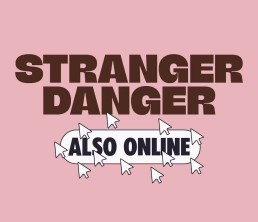
Online dangers, real consequences: Terre des Hommes’ campaign to keep children safe
Online dangers, real consequences: Terre des Hommes’ campaign to keep children safe
The digital world offers children incredible opportunities for learning and connection, but it also exposes them to serious risks. Across the globe, children face online sexual exploitation in various forms, including grooming, sexual extortion, livestreamed abuse, and the spread of child sexual abuse materials (CSAM).
A 2024 global study by Childlight found that more than 300 million children have experienced some form of online sexual exploitation or abuse in just the past year.
One of the most disturbing trends is the coercion of children into producing sexual content. Research from the Disrupting Harm project (2021) shows that 7% of children aged 12–17 have been offered money or gifts in exchange for sexually explicit images or videos, while 3% have faced threats or blackmail to engage in sexual acts online. Equally concerning is that 7% of children have had their private sexual images shared without consent—a violation that leaves deep emotional scars.
“At my home, my children talk of TikTok, Snapchat and other social media chatting sites. I have no information about what they do or see in those chats. I am unable to control or restrict them as I don’t know if those sites are bad,” Father, Nairobi, Kenya.
Terre des Hommes Netherlands conducted a multi-country study on Online Child Sexual Exploitation (OCSE) across Cambodia, Kenya, Nepal, and the Philippines to understand parents’ roles in prevention and response.
The research revealed that most parents and caregivers remain unaware of the threats their children face in digital spaces and struggle to keep up with the digital landscape. This highlights a troubling gap in awareness and communication between adults and young people when it comes to online safety which has serious consequences.
Many children who experience online exploitation hesitate to confide in their parents, fearing blame, punishment, or disbelief. Instead, they turn to friends or school counselors—if they speak up at all. Without trust and open dialogue, abusive situations often go unreported, allowing perpetrators to continue harming children unchecked.
To address this urgent issue, Terre des Hommes Netherlands has launched the “Also Online” campaign, a global initiative designed to empower parents and caregivers with the knowledge and tools they need to protect children in digital spaces.
Through practical guides and resources available on the website of Terre des Hommes Netherlands, families can learn how to discuss topics like privacy, consent, and safe online behavior in an age-appropriate way.
The internet is an integral part of children’s lives, and protecting them requires a proactive, informed approach. Parents, educators, and policymakers must work together to strengthen safeguards and ensure children can explore the digital world without fear.
Terre des Hommes International Federation is committed to ending online child exploitation and building a safer internet for every child by raising awareness, improving digital literacy, and fostering trust within families.
Visit the campaign website to access free resources and join the movement to protect children—online and offline.
TDHIF members reaffirm their support to the right to know one’s origins
TDHIF members reaffirm their support to the right to know one’s origins
The Terre des Hommes International Federation (TDHIF) has recently been approached by some media regarding a complaint related to illegal adoptions from South Korea in Belgium.
TDHIF serves to coordinate and ensure exchanges between its nine operationally independent member organisations that are located in Denmark, France, Germany, Italy, Luxembourg, the Netherlands, Spain and Switzerland.
All TDHIF member organisations recognize and strongly support the right to know one’s origins. Only a few of them facilitated adoptions. Those who offered such services in the past support people adopted in their efforts to find their origins. However, they engage in such research or facilitation of research solely upon request of the adoptees. They will not, under any circumstances, comment on any aspects of this research publicly, as the stories of adoptees are theirs only.
International adoptions have not always respected the rights of children and their families. TDHIF recognises that, in the past, irregular practices have occurred, sometimes with serious consequences. These situations call for reflection, responsibility, and support for those affected. All TDHIF member organisations are committed to promoting children’s rights, ensuring their protection, and upholding the principle that the best interests of the child must always prevail and guide our actions.
At this time, neither the TDHIF nor any of its member organisations currently have knowledge of what organisation is implicated in the opening of the judicial process in Belgium.
Unprecedented Attacks on NGOs in the EU - 570+ orgs join forces to defend civil society
Unprecedented Attacks on NGOs in the EU - We Call on All Democratic Forces To Act for a Strong and Independent Civil Society
European civil society organisations (CSOs) are currently facing an unprecedented attack coming from certain Members of the European Parliament. The attack, spearheaded by some MEPs from the European People’s Party (EPP) and by the far-right groups, is fuelled by disinformation. The attack resorts to misleading arguments to artificially fabricate a scandal, and is carried and amplified by badly informed media articles. At a time when democratic values are being eroded across the EU and Member States, and civic actors acting for these values are increasingly under attack, this renewed offensive on funding for CSOs and on our legitimacy in the democratic process risks not only shrinking European civic spaces further but weakening democracy as a whole.
Disinformation from elected Members of Parliament
On 22 January 2025, some MEPs brought a targeted debate to the Plenary of the European Parliament (EP) on public funding of NGOs, focusing on environmental civil society organisations receiving operating grants under the LIFE programme. The debate raised questions about the legitimacy for CSOs to get such subsidies from the European Commission to carry out their missions. Many MEPs spoke in favour of the right of citizens organisations to engage in the democratic process. However, some MEPs mismatched arguments, suggesting that environmental organisations had been paid by the Commission to lobby the European Parliament on its behalf. This false narrative brings together opponents to the European Green Deal and adepts of conspiracy theory. MEPs wrongly spoke about fictional amounts of billions of Euros going to CSOs. False claims that CSOs were not duly using the Transparency Register were made – even though EU transparency measures resulted from campaigns by civil society, and CSOs were amongst the first adopters when they were put in place.
Why should CSOs receive public funding?
The focus of the current attacks is the EU’s LIFE programme, the main funding instrument for nature conservation and climate action.
For a strong civil society, the development of a framework for civil dialogue based on Art.11 TEU is a priority for this five-years term for the EU institutions. Properly resourcing civil society organisations to engage in this dialogue by involving their constituencies across Europe is crucial. In the EU, as in any democracy, public funding is needed to support the work of civil society organisations whose mission and objectives are strengthening the values enshrined in the treaties and the Charter of Fundamental Rights.
It totals around €700 million per year. As part of this programme, the EU Commission allocates €15.6 million annually across a number of environmental NGOs in compliance with the provisions agreed by the European Parliament and the EU member States after a competitive and open procedure to support civil society’s invaluable role in providing evidence-based, scientifically supported and constructive recommendations to policymakers on issues that matter to people.
These funds are already dramatically insufficient to pursue the goals they are tasked to support: create a level-playing field, helping policy makers access information, fact- based evidence and best practices from the ground; and hear about citizens’ needs and expectations for their health and wellbeing, social inclusion and equality, their rights and justice, the promotion of the rule of law, the fight against corruption, and a healthy environment for current and future generations. Millions of citizens support these contributions to EU policies, through national, local and grassroots constituencies, volunteering and community engagement, provision of services and access to rights for the most vulnerable and excluded.
It is a characteristic of authoritarian regimes that institutions consider no intermediary bodies are needed and that citizens are fully and only represented by the leaders they elected. Indeed, the current debate illustrates the overall confrontation underway between European values and autocratic perspectives.
We call on all democratic forces to oppose false narratives and disinformation around the role of civil society organisations, to protect our unique role in European democracy and to support public funding for civil society. Civic participation is an essential pillar of our shared European values. We call on decision-makers to ensure a robust legal framework in which civil society and citizens organisations can thrive and play their role in interacting with policy-makers in order to have a more fully informed decision-making process. Democracy is about the right of citizens to be collectively heard for building an inclusive society and a shared European future and properly funded independent CSOs are a crucial tool for that.
Find the list of open letter signatories here.
Protecting Children in the Digital Age: How AI impacts child rights
Protecting Children in the Digital Age: How AI impacts child rights
The digital revolution has transformed the world, offering incredible opportunities for children to learn, connect, and grow. From access to education and healthcare to new forms of play and creativity, digital technologies have the power to unlock potential like never before. Artificial intelligence (AI) can also help children, making learning easier and more personalised, enhancing their creativity, promoting critical thinking, and developing problem-solving skills. But with these advancements come serious online risks to children —cyberbullying, exploitation, and the dark side of artificial intelligence (AI), including AI-generated sexual abuse imagery. How do we ensure a safe digital future for every child?
This March, the UN Committee on the Rights of the Child (CRC) and Grigol Robakidze University co-hosted, together with other international partners, a dedicated Conference on Child Rights and the Digital Environment, Including AI. Held from March 10-12, 2025, in Tbilisi, Georgia, this event marked the 35th anniversary of the Convention on the Rights of the Child. It was a unique platform to address the challenges and opportunities digital technologies and AI present for children’s rights.
Why This Matters
The rapid expansion of the digital environment, including AI, has created unprecedented opportunities for the realisation of children’s rights. However, it also poses significant challenges. Children today face threats to their privacy, exposure to harmful content, and new forms of abuse and exploitation, such as AI-generated child sexual abuse material (CSAM) and deepfake revenge porn. These issues are not just technological—they are deeply rooted in child rights violations.
The conference built on the UN Committee on the Rights of the Child’s General Comment No. 25 on children’s rights in relation to the digital environment and served as an important platform to foster dialogue on how different stakeholders can collaborate to address the challenges children face online. The Conference brought together representatives from international organisations, governments, academia, civil society, and children themselves to ensure their voices are heard in shaping policies that affect their lives.
Two experts from Terre des Hommes International Federation participated in the Conference and shared critical insights during the session on “AI Governance for Child Rights” .
Nathalie Meurens, Senior EU Advocacy Manager from Terre des Hommes Netherlands, brought a regional/EU perspective, focusing on the urgent need to regulate AI-generated child sexual abuse material (CSAM). She highlighted the false belief that AI-generated CSAM is victimless and harmless. In reality, such content contributes to the sexual objectification of children, normalises abuse, and can lead to increased demand for real CSAM. Nathalie emphasised the importance of criminalising all forms of CSAM, regardless of how they are produced or used.
Federica Giannotta, Head of Advocacy and Domestic Programmes from Terre des Hommes Italy, provided a national perspective from Italy, showcasing Terre des Hommes’ multi-level approach to protecting children from online violence. This includes giving children a voice to understand emerging trends, advocating for legislative reforms to increase the online protection of children and monitoring the implementation of the Digital Services Act (DSA) in Italy. Federica also highlighted the need to expand legal definitions of revenge porn to include AI-generated content, such as deepfake sexual images, which are not currently covered under Italian law.
The conference was a call to action for governments, policymakers, and the international community to prioritise child safety in the digital age. Terre des Hommes will advocate for strong legislation to tackle the dark side of technology, emphasising that all AI-generated CSAM, regardless of how it was produced, and its intended use, and revenge porn must be criminalised.
There is also a pressing need to raise awareness about emerging forms of AI-driven abuse, such as deepfake sexual images of children. These virtual images, created using AI programs, often appear real and can cause significant harm. Yet, many countries lack the legal frameworks to address these crimes effectively.
By fostering dialogue and collaboration among diverse stakeholders, a unified approach to safeguarding children’s rights in the face of AI’s growing influence can be established.
Let’s work together to create a digital world where every child is safe, respected, and empowered.